
What does an LPN label look like?
Amazon LPN stands for License Plate Number. It is a unique barcode identifier used in Amazon warehouse operations to track individual items or handling records, especially products processed through customer returns.
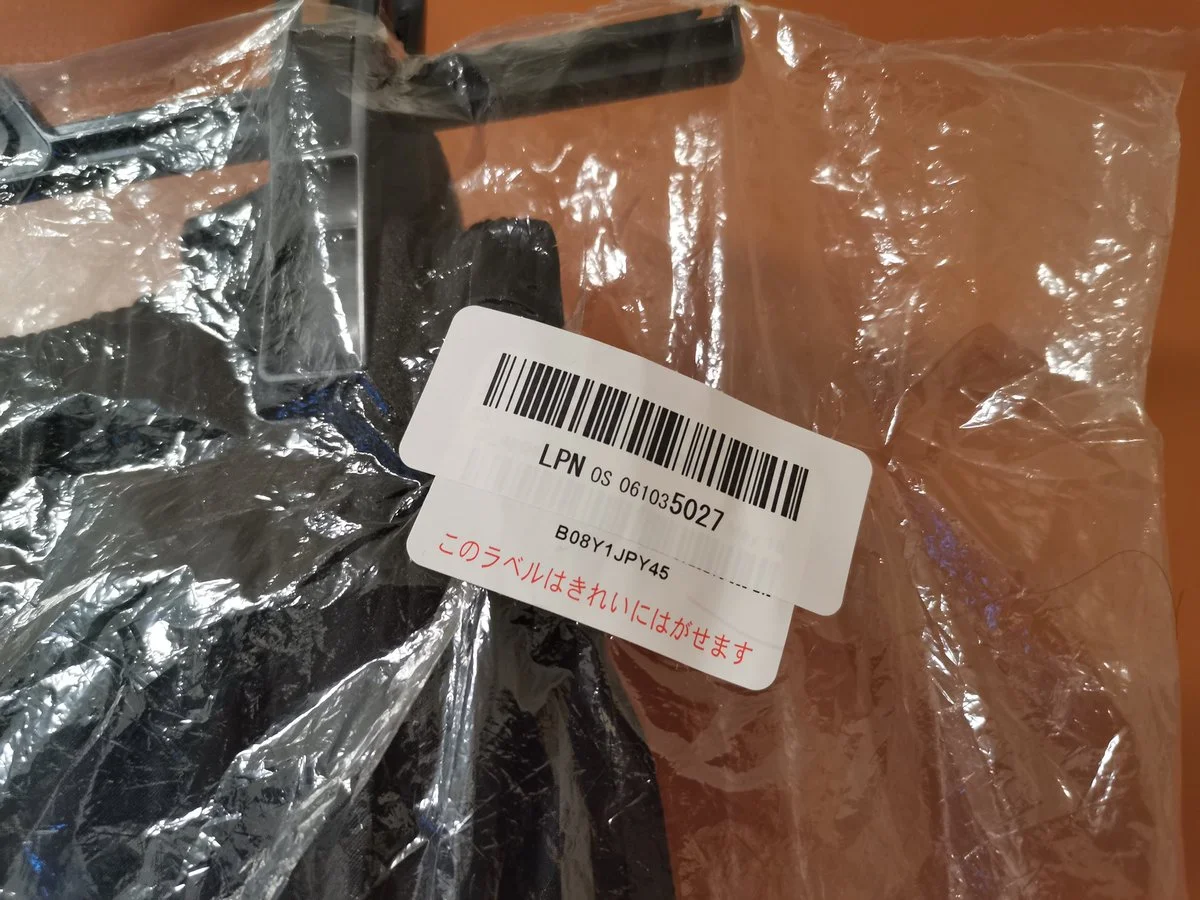
The label is typically a white sticker on the product or its packaging, with a barcode and a readable identifier beginning with LPN. Formats vary; the real label pictured above is one example.
Illustrative identifier: LPN RR EX823… (example only; not a valid Amazon-assigned number).
Why does Amazon use LPN labels?
- Track a specific returned item through warehouse processing.
- Associate an item with return and inventory-handling records.
- Support inspection and inventory disposition decisions.
- Track units returned to sellers or routed into other workflows.
- Help investigate discrepancies, damage, or incorrect processing.
See Amazon’s explanation of LPN labels for their role in returns tracking.
LPN vs. FNSKU vs. ASIN vs. UPC
| Identifier | Primary purpose | What it identifies |
|---|---|---|
| LPN | Warehouse and return tracking | A particular physical unit or handling record |
| FNSKU | Amazon FBA inventory labeling | Seller-specific inventory identification |
| ASIN | Amazon product catalog | A catalog listing |
| UPC | Standard retail barcode | A product type |
If 20 units of the same headphones are returned, each may receive a different LPN even though they share the same ASIN and UPC.
For preparing seller inventory, read our FNSKU label guide. For unit authentication, see our Transparency label guide.
Does an LPN label mean the product is used?
A tracking label is not a condition report
No. An LPN often indicates a return or warehouse handling process. It does not, by itself, prove that the item was opened, used, damaged, defective, or fully inspected. Some returned products are unopened and in excellent condition.
Inspect the actual product, packaging, seals, and accessories. Record your findings separately from the barcode, and contact the seller or Amazon if the item does not match the condition you ordered.
Can sellers look up or generate LPN labels?
Look up returns in your own seller account
The seller who sold the item can use its LPN to find information in the FBA Customer Returns report. Access requires the appropriate seller account; an LPN is not a public lookup key for another seller’s return history.
Amazon’s returns report documentation lists a license-plate-number field alongside return details. If you cannot match a label, check your account, marketplace, and report date range before contacting Seller Support.
Amazon assigns its own LPNs
Unlike seller-prepared FNSKU labels, Amazon LPNs are assigned within Amazon’s warehouse systems. Printing an arbitrary LPN barcode does not create a matching Amazon inventory record.
Recording LPNs for returned inventory
Returns resellers and liquidation teams can record the LPN exactly as printed, alongside a product description, receipt date, photos, and their own inspection notes. Keep each physical unit associated with the correct record.
A possible Ship Toolkit scanner
A proposed LPN Barcode Scanner could let users scan or enter codes, keep a local inventory list, and export it to CSV or Excel. This is a feature idea, not a currently available Ship Toolkit tool.
Decoding or recording an LPN does not reveal Amazon’s private return history or condition records. That information requires a separate authorized data source.
Key takeaway
FNSKU identifies seller inventory in FBA; LPN tracks specific units and warehouse handling, often after a return. Read the barcode as an identifier, then verify the product and its condition separately.
Explore all guides